Key Takeaways
- 92–95% of car buyers research online before visiting a dealership, spending 14+ hours comparing vehicles, prices, and reviews
- Google Local Pack’s top 3 positions capture 70% of clicks; rank #1 captures 30-35%, rank #4 drops to 3-5%
- 76% of mobile searchers visit a dealership within 24 hours of finding it online; invisible dealerships get zero walk-ins
- 88% of consumers trust online reviews as much as friend recommendations; below-4.0 stars eliminates 86% of potential buyers
Why Are Southern Oregon Dealerships Invisible to Modern Car Buyers?
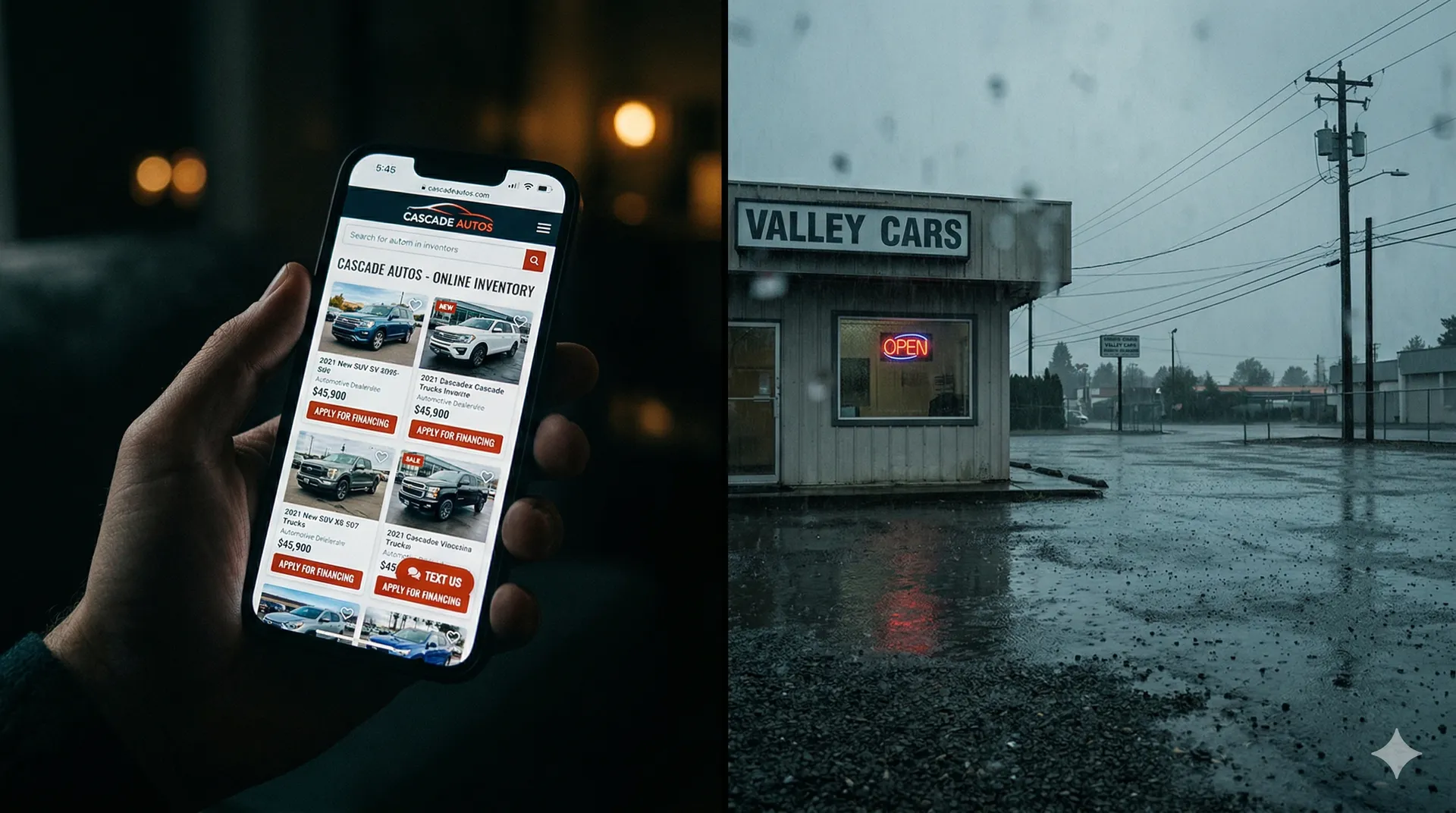
There’s a used car lot on Highway 99 in Ashland that’s been there for twelve years. The owner—let’s call him Mike—knows his inventory inside and out. He’s built a solid reputation with people who know to find him. But in 2026, something shifted. Foot traffic dried up. When Mike finally checked, he discovered why: he doesn’t show up on Google when someone searches “used cars near me” or “cheap trucks in Ashland.”
His story is playing out across Southern Oregon right now, and it’s the defining business crisis of dealership retail in 2026.
Modern car buyers don’t start their journey on a lot anymore—they start on their phone. 92 to 95% of car shoppers now begin research online, spending over 14 hours researching vehicles, pricing, dealer reputations, and reviews before they ever step on a dealership lot. This isn’t a trend slowing down; it’s the entire market now.
Buyers who discover your dealership through online research have already decided to visit you. They’re pre-qualified, motivated, and ready to buy. The dealership they can’t find online simply doesn’t exist to them.
The numbers quantify the shift: 26% of all used car sales now originate from online leads, up from 20% just three years ago. This is a fundamental reordering of where sales come from. Dealerships not competing for those online-originated leads are watching their market share get redistributed to competitors that are.
How Does the Google Local Pack Determine Which Dealerships Win in Medford and Grants Pass?
When a buyer in Medford searches “used trucks near me” or a Grants Pass shopper searches “used cars 4000 down payment,” Google displays a “Local Pack”—three dealerships highlighted with a map, photos, star ratings, and reviews. Those three positions are where the market lives now.
The concentration is staggering. The top three positions capture 70% of all clicks from local search. Rank #1 captures 30-35% of clicks. Rank #4 captures 3-5%. The difference between visible and invisible is measured in weekly vehicle sales lost.
Real Impact: Monthly Search Volume and Sales Conversion by Rank
Assume a typical Medford-area buyer searches “used vehicles near me” roughly 500 times per month across varied queries. Here’s the real sales impact at different visibility levels:
| Online Visibility Level | Monthly Clicks | Lead Conversion Rate | Monthly Vehicle Sales | Annual Sales Attributable to Search |
|---|---|---|---|---|
| Rank #1 (Top Local Pack) | 150–175 | 15% | 22–26 vehicles | 264–312 vehicles/year |
| Rank #2–3 (Local Pack) | 100–125 | 15% | 15–19 vehicles | 180–228 vehicles/year |
| Rank #4–7 (Outside Pack) | 15–25 | 15% | 2–4 vehicles | 24–48 vehicles/year |
| No Online Presence | 0 | 0% | 0 vehicles | 0 vehicles/year |
At $1,800 average gross profit per vehicle, the difference between rank #1 and rank #4 is $432,000-$505,000 in annual profit difference. The difference between visible and invisible is the difference between a sustainable dealership and bankruptcy.
Butler Automotive Group dominates local search across Medford and Ashland. They don’t just rank high—they own the top positions. Everything else in their business strategy follows from this single fact: they show up first, everywhere buyers search.
How Does Mobile Search Drive Immediate Dealership Visits in Southern Oregon?
Buyers don’t research vehicles on desktop anymore. They shop on smartphones while sitting on couches, during lunch breaks, standing in grocery store lines. Over 70% of car research now happens on mobile devices.
And here’s the brutal reality: if your dealership website is clunky on mobile—slow to load, hard to navigate, no inventory visibility—you’re invisible. A desktop-optimized site that performs poorly on phones isn’t a minor inconvenience; it’s a lost sale, measured in real customer abandonment.
The opportunity is immediate. Mobile searches for “used cars near me” and dealership-specific queries have grown 200%+ in recent years. But the critical insight: 76% of people who conduct a local mobile search visit that business within 24 hours. A buyer finding you on their phone at 6 PM is walking into your lot by 5 PM the next day. The dealership they find online is the dealership they visit.
Critical Data Point: Mobile-first car shoppers have already narrowed their list before arriving. They’re not comparison shopping at your lot—they’ve already compared online. Your job is confirming the choice they made before they arrived.
For independent dealerships like Rigs & Rides (Medford), Quality Cars (Grants Pass), and TC Chevy (Ashland), this creates both problem and opportunity. Without mobile optimization and mobile local search visibility, you’re losing foot traffic to competitors. But if you can optimize mobile experience and compete for high-intent mobile searches, you capture walk-ins that franchise dealerships might miss because franchises compete on price and volume—not on speed, accessibility, and customer experience online.
Why Do Google Reviews Now Act as Your Primary Sales Team?
A buyer finds you on Google. They click your listing. But before calling or visiting, they scroll down and read reviews. That’s the next decisive battle, and it’s not minor.
88% of consumers trust online reviews as much as they’d trust a recommendation from a friend. That’s parity, not preference. 81% of car shoppers actively read reviews during research. If you rank high on Google but your rating is 3.2 stars—filled with complaints about bait-and-switch pricing or pushy sales—you’ve already lost before the buyer pulls into your lot. They click “back” and visit a competitor.
The bar is unforgiving. 86% of consumers won’t consider a business rated below 4.0 stars. Four stars. That’s the baseline entry point. Once buyers read actual reviews (not just star counts), they’re evaluating whether you’re a dealership they want to spend hours with.
| Star Rating | Consumer Perception | Impact on Dealership | Typical Review Themes |
|---|---|---|---|
| 4.8–5.0 | ”Trustworthy; fair dealing” | 85%+ consider visiting; zero discount pressure; high F&I penetration | ”No pressure,” “honest,” “transparent pricing” |
| 4.0–4.5 | ”Acceptable; some risk” | 60% consider; moderate negotiation pressure; 5-10% lower F&I penetration | Mix of “good experience” and minor complaints |
| 3.5–4.0 | ”Maybe; better options exist” | 30% consider; heavy discount pressure; 15-20% lower F&I penetration | More complaints; doubt about pricing honesty |
| Below 3.5 | ”Untrustworthy; avoid” | 10% consider; forced to discount heavily; minimal F&I sales possible | Bait-and-switch, pressure tactics, mechanical failures |
Butler Automotive Group (4.8–4.9 stars) has built an unbeatable moat. Buyers searching “used trucks near me” find Butler, scroll reviews, read dozens of five-star testimonials praising “no-pressure sales,” “fair pricing,” “great service”—and they’re already mentally committed before arriving. They expect excellence because fifty conversations prove it’s real.
By contrast, a dealership with 3.7 stars and reviews complaining about “overcharging” or “high-pressure tactics” faces an uphill battle on every transaction. They must prove negative reviews are outliers. That exhausting work saps margins. A buyer primed to distrust you will negotiate harder and stay less loyal—forcing heavy discounts that erode the profit margin you needed.
How Has the Digital Divide Created Three Tiers of Southern Oregon Dealerships?
The digital divide in Southern Oregon maps directly onto dealership tier, and the winners are unmistakable.
Tier 1: Franchise Dealerships (Butler Automotive Group, Lithia Motors, Southern Oregon Subaru, Grants Pass Automotive)
Digital Assets:
- Professional, fast-loading, mobile-optimized websites that load in under 2 seconds on phones
- Comprehensive inventory online with detailed photos, specs, pricing, and real-time availability
- Online financing tools and trade-in appraisals customers can try before visiting
- Integrated CRM systems tracking every customer interaction
- Massive paid search budgets dominating “used cars near me” keyword auctions
- Corporate resources managing and responding to every review
Result: Rank #1 on Google Local Pack. 30+ five-star reviews visible immediately. Buyers pre-sold before arrival. Annual online-sourced sales: 264–312 vehicles.
Tier 2: Independent Dealerships with Strong Reputations (Rigs & Rides, Quality Cars, Viking Motors)
Digital Assets:
- 4.8+ star ratings with dozens of five-star reviews praising “honest dealing” and “no-pressure sales”
- Smaller digital budgets, but reputation acts as social proof
- Strong community presence driving word-of-mouth and referrals
- Quick response time to reviews and customer issues
- Transparent, mobile-friendly websites (not fancy, but functional)
Result: Rank #2–3 on Local Pack. Reviews convert buyers even without paid search dominance. They compete through reputation where they can’t match franchise ad spend. Annual online-sourced sales: 180–228 vehicles.
Tier 3 & 4: Micro Dealerships (5–10 vehicles on lot)
Digital Status:
- Minimal or outdated websites (sometimes non-existent)
- Incomplete Google Business profiles missing photos, hours, or accurate inventory
- No paid search presence
- No review management strategy
- Invisible on mobile search
Result: Rank #7 or lower; not found in Local Pack. Increasingly invisible. Rely entirely on word-of-mouth and drive-by traffic—a fragile model when 76% of mobile searchers visit within 24 hours of finding a dealership online. If not found online, not visited. Annual online-sourced sales: 24–48 vehicles.
Industry Reality: In a market where 92% of buyers start online, being invisible digitally is a terminal business condition. Micro dealerships without web presence will not survive the next 2-3 years unless they invest immediately in Google visibility and mobile optimization.
Common Questions About Digital Visibility and Dealership Success
Q: How much does Google ranking actually impact dealership revenue?
For a dealership selling 150 vehicles monthly at $1,800 gross profit per unit: Rank #1 generates $432,000+ in annual profit from organic search alone (264+ vehicles). Rank #4 generates $48,000 (24-48 vehicles). The difference is $384,000–$432,000 annually—typically the difference between growth and bankruptcy.
Q: Can a small independent dealership compete with franchise dealerships on Google?
Yes—through reputation and local SEO optimization. Rigs & Rides and Quality Cars rank #2–3 in many searches despite smaller ad budgets, because their 4.8+ star ratings signal trustworthiness. Google’s Local Pack algorithm weights both paid ads and organic ranking (review count, star rating, customer engagement).
Q: How quickly can a dealership improve its Google ranking and visibility?
Mobile optimization and Google Business Profile updates show results in 2-4 weeks. Paid local search ads start driving traffic immediately. Building organic ranking and star rating takes 3-6 months of consistent review management and website optimization.
Q: Why do reviews matter more than having the lowest price on Google?
Because a buyer reading “this dealership ripped me off” scrolls past a low price. Conversely, a buyer reading “honest, fair, no pressure” clicks on a mid-range price and expects to buy there. Reviews are trust signals that unlock pricing power and reduce negotiation friction.
Q: What’s the minimum digital investment a dealership needs to stay competitive?
(1) Mobile-optimized website with inventory visible within 2 clicks ($3,000–$5,000 one-time). (2) Google Business Profile with accurate hours, photos, complete inventory ($0). (3) Local search ads for top-converting keywords ($1,000–$2,000/month). (4) A systematic review management process ($500–$1,000/month for a service). Total: ~$15,000–$20,000 annually. For a dealership selling 150 vehicles, this ROI is 20–30x.
Why the Digital Divide Is Redefining Dealership Success
The Southern Oregon used car market has been completely remade by digital. The buyer who pulls into your lot didn’t find you by driving past a sign. They found you on their phone, read your reviews, and decided you were worth visiting. That buyer has already decided whether to trust you. Your job is confirming that decision—or proving it wrong.
For dealership owners, the reality is stark: If you’re not ranking in local Google search, if your website doesn’t load on mobile, if your reviews signal dishonesty—you’re not in the market. You might believe you’re selling cars on the lot, but you’re hoping someone accidentally drives past. That’s not a business; that’s gambling.
For buyers, the digital divide creates inequality. A shopper knowing how to search and evaluate reviews finds dealerships with best reputations and most competitive pricing. A less digitally-savvy buyer—or one without internet—ends up at whatever lot they happen to see, often paying more and having worse experiences.
Strategic Insight: The dealerships thriving in Southern Oregon’s market are those understanding this transformation completely. For franchises, digital visibility must convert into genuine customer experience. For independents, exceptional reputation (reflected in reviews) combined with mobile-first visibility creates a competitive moat against franchise price advantage.
The Rogue Valley car market has split into two worlds: the digital world (where 92% of buyers start) and the remainder. The dealership operating in both—winning the digital battle while delivering excellent in-person experience—will own the market.