Key Takeaways
- Dealerships underestimate recon costs by ~$600 per vehicle during appraisal; $54,000/month budget misses at 60-vehicle acquisition volume
- Velocity is more profitable than margin: a vehicle turning in 28 days at 15% margin outperforms one turning in 65 days at 20% margin after holding costs
- Strategic recon investment increases asking price 8–12%, allowing buyers to perceive value (not discount need), reducing negotiation friction
- Recon quality directly drives F&I penetration: customers trusting vehicle condition are 2–3x more likely to purchase warranties and protection plans
How Do Recon Cost Estimation Errors Destroy Monthly Profit Margins?
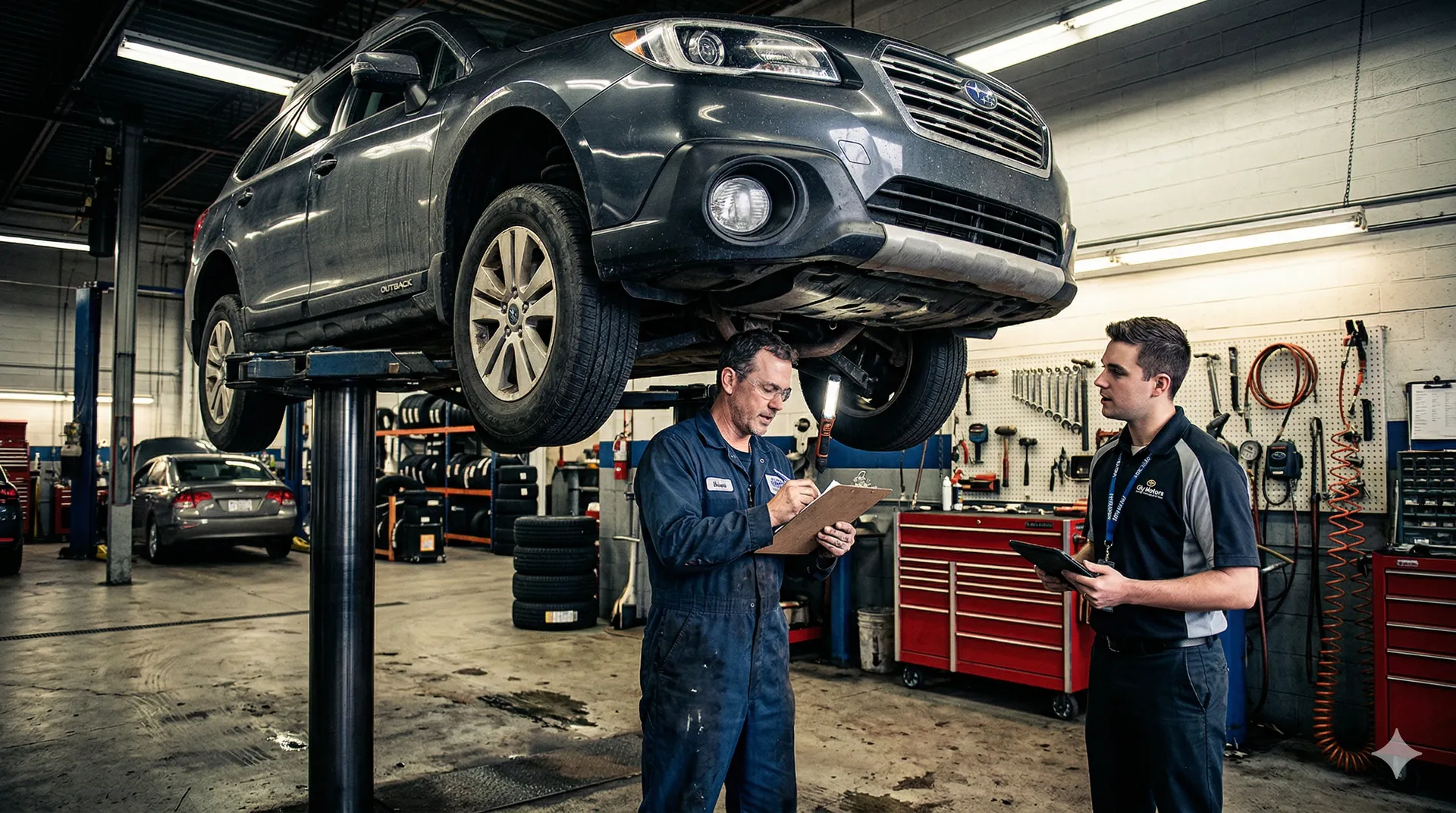
It’s 9:00 AM on Tuesday at Quality Cars in Grants Pass. A used car buyer approves a trade-in for reconditioning. The appraiser estimates $800 in work: oil change, filters, brake pads, detailing.
By noon, the technician discovers: transmission fluid contaminated (actively burnt from heat cycles). Brake pads worn, one rotor warped. Tires assessed as “worn but passable” are actually one puncture from blowout. Final recon bill: $1,450—$650 over estimate.
This happens at dealerships constantly. Dealerships typically underestimate recon costs by approximately $600 per vehicle during initial appraisal. A dealership buying 150 vehicles monthly with 60% underestimation rate = $54,000/month in unexpected costs. Over 12 months: $648,000 in margin erosion—enough to swing profitable dealerships into loss.
The gap doesn’t vanish. It’s absorbed as missing profit that was supposed to exist but never shows up.
Recon Cost Ranges and Estimation Accuracy Challenge
| Work Category | Low Estimate | High Estimate | Accuracy Risk |
|---|---|---|---|
| Cosmetic/detailing only | $300 | $600 | Low risk; visible work |
| Moderate repairs (brakes, fluids, belts) | $800 | $1,200 | Medium risk; hidden issues common |
| Significant mechanical (transmission, engine) | $1,500 | $2,500+ | High risk; surprises routine |
| Industry standard underestimate | — | — | ~$600 per vehicle (40%+) |
The accuracy of recon estimation is a critical operational discipline. Dealerships systematically underestimating recon costs train their used car buyers to avoid vehicles requiring moderate work, shrinking inventory selection and forcing reliance on expensive auction sources.
Why Is Strategic Recon Investment More Profitable Than Cost Minimization?
Viewing reconditioning solely as a cost to minimize represents a strategic misunderstanding. Reconditioning is not a cost center—it is an investment in retail value and salability.
The Math: Two Identical Vehicles, Different Recon Strategies
| Metric | Vehicle A: Minimal Recon | Vehicle B: Strategic Recon |
|---|---|---|
| Acquisition cost | $12,000 | $12,000 |
| Recon estimate | $400 | $1,600 |
| Actual recon cost | $850 | $1,850 |
| List price | $13,800 | $15,200 |
| Days on lot | 65 days | 28 days |
| Holding costs (avg. $60/day) | $3,900 | $1,680 |
| Total cost | $16,750 | $15,530 |
| Gross profit | -$950 (LOSS) | -$330 (NEAR-BREAK) |
But examine inventory turnover across the month:
- Vehicle A Scenario: 4 vehicles/month × -$950 = -$3,800 monthly loss
- Vehicle B Scenario: 8 vehicles/month (faster turnover, same lot space) × -$330 = -$2,640 monthly loss, but sold double the volume at better pricing
The deeper insight: a thoroughly reconditioned vehicle:
- Justifies 8–12% higher asking price through increased buyer confidence (“This vehicle was professionally inspected”)
- Reduces negotiation friction because buyer perceives value, not desperation
- Turns faster (28 vs. 65 days), reducing holding costs and freeing lot space for fresh inventory
- Generates higher F&I penetration because customers trusting vehicle condition are 2–3x more receptive to extended warranties and protection plans
Critical Insight: A vehicle turning in 28 days at 15% margin ($1,800 gross profit) is MORE profitable than one turning in 65 days at 20% margin ($2,400 gross profit) after accounting for holding costs and floor plan interest.
How Do Top Dealerships Balance Recon Investment Against Cost Control?
Successful dealerships manage reconditioning as a disciplined investment, not a grudge expense:
1. Accurate Estimation (Prevent Margin Surprises)
- Train appraisers rigorously on common hidden issues (transmission fluid condition, rotor wear, electrical systems)
- Create standardized checklists (service bay inspection list covering 40+ items)
- Build contingency buffers (add 15–20% to all estimates; better to be right than surprised)
- Track actual vs. estimated recon monthly; identify estimation patterns
Result: Reduce $600 average underestimate to $150–$200; regain $45,000+/month in expected margins
2. Strategic Prioritization (Invest in Fast-Turning Vehicles)
- Focus recon on high-demand body styles (SUVs, compact crossovers, popular sedans)
- Deprioritize vehicles requiring $2,000+ recon—sell at auction instead
- Identify which recon spend actually accelerates sales (new tires = faster turnover; fancy paint protection = does not)
Result: Deploy limited recon budget to vehicles turning fastest; maximize capital efficiency
3. Cost Control Without Quality Compromise
- Charge internal labor at 60–75% of retail rates (leveraging in-house efficiency)
- Use high-quality non-OEM parts where appropriate (aftermarket brake pads, quality oil, aftermarket batteries)
- Negotiate volume pricing with tire suppliers, battery vendors, service contractors
- Never compromise on safety-critical items (brakes, suspension, electrical systems affecting safety)
Result: Reduce recon cost per vehicle by 10–15% without quality loss
4. Velocity as Primary KPI (Not Margin Per Vehicle)
- Measure “days to turn” as a primary metric, not just gross profit/vehicle
- A vehicle turning in 28 days at 15% margin often outperforms one turning in 65 days at 20% margin (after holding costs and capital recycling)
- Set departmental targets: Target average holding time of 30 days (vs. 45–50 industry standard)
Why Does Southern Oregon’s Aging Fleet Create a Recon-Quality Opportunity?
Southern Oregon’s aging vehicle fleet (14.5-year average age) means incoming inventory often requires moderate to significant reconditioning. This is challenge and opportunity combined.
Dealerships excelling at efficient, accurate reconditioning can:
- Differentiate on quality (critical for budget-conscious buyers who can’t afford post-sale mechanical failures)
- Command 5–8% premium pricing vs. competitors selling “as-is” auction vehicles
- Build reputation for reliability reducing negative reviews and customer complaints
Butler Automotive Group, Rigs & Rides, and TC Chevy are known for quality vehicles with minimal post-sale issues. This reputation is built on recon discipline, not luck.
| Recon Quality Strategy | Dealership Type | Impact on Reputation & Pricing |
|---|---|---|
| High-discipline recon | Rigs & Rides, Quality Cars | 4.8+ star rating; command premium pricing; lower F&I friction |
| Moderate discipline | Mid-market independents | 4.0–4.3 stars; average pricing; moderate negotiation |
| Low discipline (“as-is” auction model) | Micro dealers, BHPH | 3.2–3.7 stars; forced to discount; high negotiation friction |
Southern Oregon’s aging fleet becomes an advantage for quality-focused dealers and a liability for cost-cutters.
How Does Recon Quality Build a Reputation Moat?
A customer buys from Rigs & Rides known for quality recon. Two years later, vehicle is running perfectly. No transmission issues. No brake failures. No surprise repairs. That customer becomes a referral source and loyal repeat buyer.
By contrast, a customer buys from a competitor cutting recon corners. Six months later, they’re back complaining about $1,200 in repairs the dealership should have caught. That customer becomes a negative Google review.
In a market where reputation drives conversion and F&I penetration, quality recon is worth more than the cost of preventive work.
| Scenario | Recon Investment | Reputation | Buyer Behavior | F&I Penetration | Repeat Rate |
|---|---|---|---|---|---|
| Quality recon ($2,000+) | Higher upfront | 4.8 stars; “reliable vehicles” | Price-insensitive; trusts dealer | 60–75% | 35–40% |
| Moderate recon ($1,200–$1,600) | Balanced | 4.0–4.3 stars; acceptable | Moderate negotiation | 40–50% | 20–25% |
| Minimal recon ($400–$600) | Lower upfront | 3.2–3.7 stars; complaints | Heavy discount pressure | 20–30% | 5–10% |
A 4.8-star dealer attracts price-insensitive buyers and captures 60–75% F&I penetration. A 3.5-star dealer must discount aggressively just to overcome customer skepticism—before even discussing warranties.
Long-term Math: Recon quality investment of $800–$1,200 extra per vehicle costs $120,000–$180,000 monthly (150-vehicle dealership). But it drives:
- 20–35% higher pricing power ($500–$1,000/vehicle) = $75,000–$150,000 monthly
- 30–40 percentage point higher F&I penetration = $60,000–$100,000 additional monthly F&I revenue
- 25% higher repeat customer rate = $30,000+ monthly from loyalty Total impact: +$165,000–$350,000 monthly profit from recon quality investment.
Common Questions About Recon Investment and ROI
Q: How much recon investment is “too much” before it starts eroding margin? A: It depends on acquisition cost and expected retail price. For a $12,000 acquisition targeting $15,200 retail (27% margin), $1,600–$1,800 recon is justified. For a $8,000 acquisition targeting $10,500 retail (31% margin), $600–$800 is the limit. The rule: recon should not exceed 15% of expected retail price.
Q: How quickly does recon quality show up in Google reviews and reputation? A: 30–60 days. First vehicles through recon quality processes show up in customer experiences and reviews within a month. By 90 days, pattern is visible. By 6 months, reputation shift is measurable in review volume and sentiment.
Q: Can a dealership build a quality reputation if it’s buying from auctions (no service history)? A: Yes, but much harder. Auction vehicles require more aggressive recon investment to compensate for unknown history. Dealerships like Rigs & Rides and Quality Cars have built reputation partly through trade-in sourcing (better history) + quality recon. Pure-auction dealers require exceptional appraisal accuracy + preventive recon.
Q: What’s the payback period for investing in recon estimation training? A: Typically 2–4 months. Reducing $600 average underestimate to $150 across 150 monthly vehicles = $67,500/month margin recovery. Training investment of $5,000–$10,000 pays for itself in first month.
Bottom Line: Recon Is Not a Cost—It’s a Profit Multiplier
Reconditioning is not a cost to minimize—it’s a strategic investment in salability, velocity, and reputation.
Dealerships that:
- Systematically improve recon estimation accuracy
- Invest in thoroughness where it justifies faster turnover
- Build quality reputation through consistent vehicle reliability
…will achieve superior profitability and customer satisfaction compared to competitors squeezing recon budgets.
In Southern Oregon’s affordability-squeezed market, where customers research heavily online, a reputation for quality and reliability is the most valuable competitive advantage available. It starts with recon discipline—and it compounds every month as reputation grows.
The dealership controlling recon costs while maintaining quality standards, and using recon investment to accelerate turnover and build trust, will dominate competitors who cut corners and watch vehicles languish on lots attracting negative reviews.