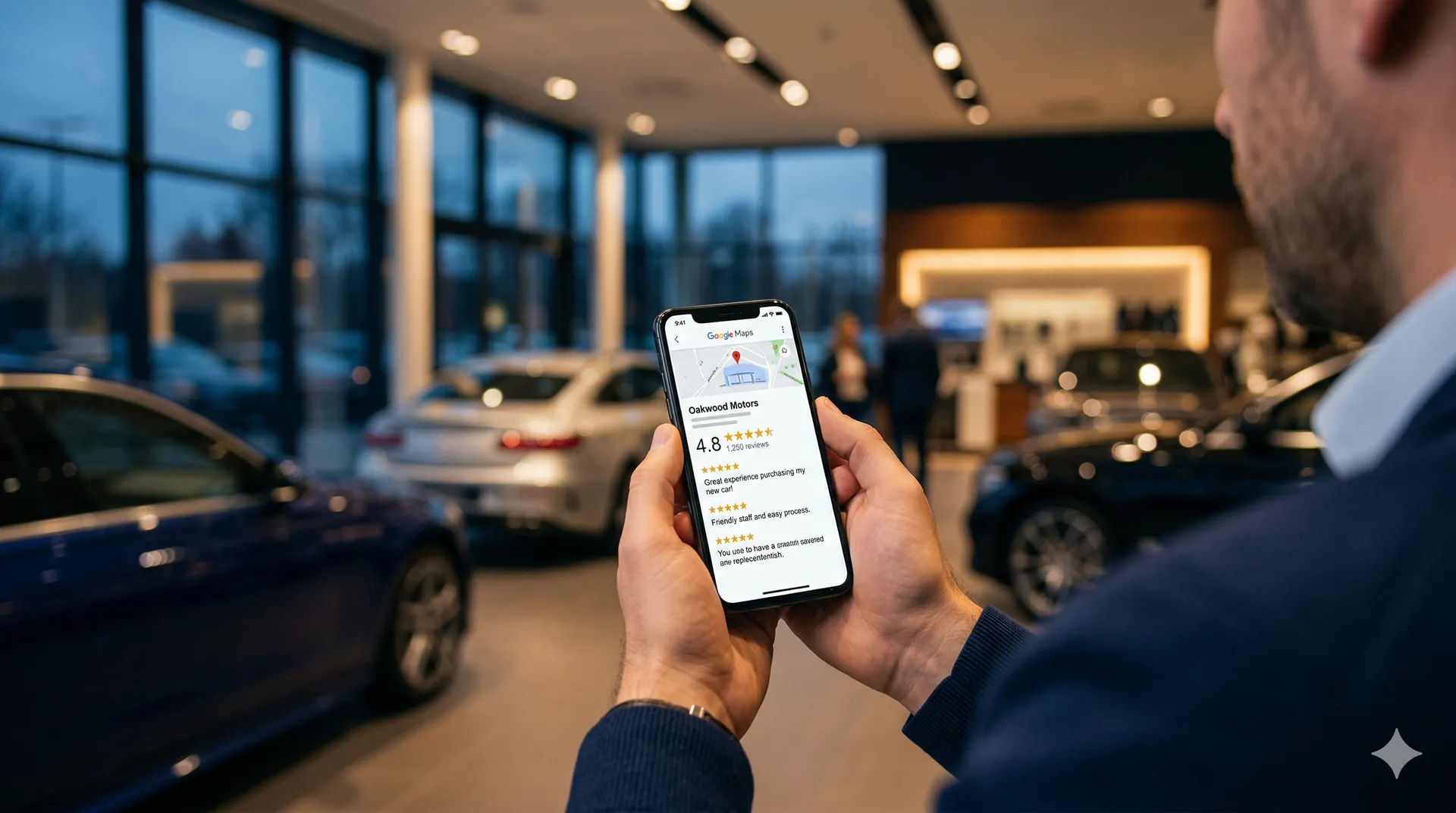
Key Takeaways
- 88% of consumers trust online reviews as much as personal recommendations; 81% of used car shoppers actively read reviews during purchasing research
- 86% of consumers won’t consider a business below 4.0 stars; top 4.8–4.9 star dealers attract 85%+ buyer consideration; 3.5-star dealers get 30% consideration
- Google reviews now gate-keep the sales process: a buyer seeing 50 five-star reviews arrives expecting excellence; a buyer reading complaints arrives defensive
- Reputation directly multiplies F&I penetration: 4.8-star dealers achieve 60–75% F&I penetration; 3.5-star dealers achieve only 20–30%
Why Do Google Reviews Now Control Which Dealerships Buyers Visit?
It’s Thursday evening in Medford. Sarah sits on her couch, phone in hand, ready to upgrade from her old truck. She googles “used Chevy trucks near me.” Google shows three dealerships in Local Pack—a franchise, a mid-size independent, smaller operation.
She clicks the franchise first. 200+ trucks on lot. 2019 Silverado at reasonable price. But scrolling reviews: 3.7 stars across 243 reviews. She reads: “Refused to honor warranty.” “Pushy salesman.” “Charged me for unexpected repairs after purchase.”
She clicks the smaller independent: Rigs & Rides. Fewer trucks on lot. No corporate website. 4.8 stars across 89 reviews. Testimonials consistent: “Honest,” “No pressure,” “Actually listened,” “Fair price,” “I was nervous but felt safe.”
By Friday morning, Sarah is test-driving at Rigs & Rides. The franchise with 200 trucks and competitive pricing lost the sale before Sarah ever saw the lot. She decided in the reviews.
This scenario is playing out thousands of times weekly in Southern Oregon. Online reputation has transcended marketing collateral and become a primary gatekeeper. A strong reputation is a competitive moat; a poor one is direct financial drag. The dealership without strong ratings never gets through the gate.
How Do Online Reputation Metrics Translate to Real Financial Impact?
The data is unequivocal:
- 88% of consumers trust online reviews as much as personal recommendations from friends
- 86% of consumers won’t consider a company rated below 4.0 stars
- 81% of used car shoppers use Google during purchasing journey; Google ratings are the de facto public reputation metric
- Top 3 Google Local Pack positions capture 70% of search clicks, but those clicks are heavily filtered by star rating—searchers skip low-rated dealerships even in top positions
Reputation’s Financial Impact Across the Customer Journey
| Star Rating | Buyer Consideration Rate | Pricing Power | Discount Pressure | F&I Penetration | Monthly Profit Impact (150 vehicles) |
|---|---|---|---|---|---|
| 2.0–3.5 (Negative) | 10–15% | Forced discount 3–5% | Severe | 20–30% | -$67,500–$90,000/month |
| 3.5–4.0 (Neutral) | 30% | Discount pressure 1–2% | Moderate | 30–40% | -$20,000–$45,000/month |
| 4.0–4.5 (Good) | 60% | Minimal discount pressure | Low | 50–60% | Baseline |
| 4.5–5.0 (Excellent) | 85%+ | Zero discount pressure; 5–8% premium pricing possible | None | 60–75% | +$120,000–$180,000/month |
For a dealership selling 150 vehicles/month at $1,800 average gross profit and $1,400 F&I revenue per vehicle:
- 3.0-star dealer loses $67,500–$90,000 monthly vs. 4.0-star baseline
- 4.8-star dealer gains $120,000–$180,000 monthly vs. 4.0-star baseline
- Total spread: $187,500–$270,000 monthly profit difference
- Annual impact: $2.25–$3.24 MILLION in reputation-driven profit variance
How Does Butler Automotive Group Use Reputation to Dominate Southern Oregon?
Butler Automotive Group’s ranking as #1 Southern Oregon dealership is fundamentally built on online reputation. They maintain 4.8–4.9 stars across locations, with testimonials praising “hassle-free,” “no-pressure” environments and individual employee professionalism.
This stellar reputation creates a virtuous cycle:
The Butler Automotive Group Reputation Flywheel
-
High-Intent Traffic → Customers finding Butler through search already trust them (based on reviews), increasing close rates 20–30%
-
Premium Pricing Power → A 4.8-star dealer maintains $1,000–$2,000 higher pricing per vehicle than 3.8-star competitors because customers perceive value, not risk
-
Effortless F&I Adoption → Customers trusting the dealership are 3x more likely to purchase extended warranties, GAP insurance, protection packages (high-margin streams)
-
Sales Velocity → Less time overcoming objections and negotiating price; faster sales cycles; lower customer acquisition costs
-
Organic Referral Growth → Satisfied customers leave positive reviews continuously attracting new customers at near-zero cost
Result: Butler captures disproportionate market share and profitability not through price competition or inventory volume, but through reputation that precedes every salesperson.
What Happens to Dealerships with Poor Online Reputations?
Dealerships with poor online reputations face a direct profitability penalty.
Example: A Southern Oregon dealer rated 2.8 stars with complaints about “poor vehicle quality,” “mechanical failures post-sale,” “aggressive collection.” This reputation creates immediate barriers:
- Skeptical traffic → Potential customers finding them online are already defensive
- Price-only competition → Must discount aggressively to compete, stripping margin premium
- F&I resistance → Customers distrusting dealership refuse high-margin warranties and protection
- Service avoidance → Customers afraid to return for post-sale service; reputation suffers further
| Dealership Reputation Tier | Business Model Viability | Profit Outlook |
|---|---|---|
| BHPH (Buy-Here-Pay-Here) | Accepts low reputation as cost of lending model | Sustainable (high interest rates offset reputation damage) |
| Mainstream used car dealer with fewer than 3.5 stars | Terminal business condition | Unsustainable; declining over 2–3 years |
| Mainstream dealer with 4.0+ stars | Highly competitive; sustainable growth | Scalable profitability |
For mainstream used car dealerships competing against franchise groups and trusted independents, poor reputation is terminal. Without reputation, dealers have only price—and price competition destroys margins.
How Do Top Dealerships Build and Protect Strong Reputations?
Online reputation isn’t created through marketing—it’s created through operational excellence, then protected through reputation management.
Dealerships with highest ratings consistently execute:
1. Deliver Consistent, Transparent Experiences
- Clear pricing with no hidden fees or surprise F&I charges
- Honest appraisals reflecting actual vehicle condition and market value
- Realistic warranties and service commitments customers trust
- No-pressure sales respecting customer autonomy and timeline
Result: Customers feel respected; Google reviews reflect fair dealing
2. Hire and Train for Empathy, Not Pressure
- Sales teams trained to listen first, sell second
- Managers empowered to resolve complaints immediately (not escalating endlessly)
- Clear escalation paths for unhappy customers
- Accountability for review sentiment and satisfaction scores (tied to compensation)
Result: Staff internalizes customer service; positive behavior becomes default
3. Proactively Manage Online Presence
- Respond to every review (positive and negative) within 24 hours
- Identify systematic issues generating complaints; fix operationally
- Encourage satisfied customers to leave reviews (organic requests, never incentivized fake reviews)
- Monitor review trends monthly for emerging patterns
Result: Shows customers concerns are heard; improves public perception quickly
4. Use Post-Sale Service as Loyalty Tool
- Free service interactions (oil changes, tire rotations) reinforce relationship
- Surprise gestures (warranty extensions, car washes) remind customers why they bought from you
- Friction-free service that customers enjoy returning for
Result: Service interactions become repeat opportunities; loyalty builds
How Does Strong Reputation Protect Pricing Power and Profitability?
Here’s the financial reality dealerships rarely discuss openly: A dealership with 4.8-star reputation can maintain $500–$1,500 higher pricing per vehicle than 3.5-star competitor, and customers will happily accept it.
Why? Because reputation removes uncertainty. A buyer reading 50 five-star reviews (“no-pressure,” “honest,” “fair”) arrives expecting value. A buyer reading complaints arrives defensive and negotiates hard.
Reputation’s Pricing and Profit Impact (150-vehicle dealership)
| Reputation Level | Per-Vehicle Pricing | Monthly Pricing Advantage | Annual Margin Gain | F&I Penetration Impact |
|---|---|---|---|---|
| 3.5 stars (poor) | Baseline (forced discount) | -$75,000–$150,000 | -$900,000–$1.8M | 30–40% |
| 4.0 stars (neutral) | Baseline | $0 | $0 | 45–50% |
| 4.8 stars (excellent) | +$500–$1,000/vehicle | +$75,000–$150,000 | +$900,000–$1.8M | 60–75% |
For a 150-vehicle dealership: A $750 per-unit pricing advantage = $112,500 monthly margin gain = $1.35M annually—the difference between sustainable profitability and thin-margin survival.
But reputation impacts more than pricing. It drives F&I penetration: A customer trusting the dealership is 2–3x more likely to purchase extended warranties and protection packages. The difference in F&I penetration between 40% and 70% is $60,000–$100,000+ monthly in additional profit.
Reputation Multiplier: Pricing advantage ($112,500/month) + F&I advantage ($60,000–$80,000/month) = $172,500–$192,500 monthly profit difference from reputation alone.
Common Questions About Online Reputation and Dealership Strategy
Q: How long does it take to build a 4.8-star reputation if starting from scratch? A: Typically 6–12 months of consistent operational excellence + aggressive review solicitation. First 20–30 reviews establish pattern; momentum builds after that. Dealerships committing to review management see measurable rating improvement within 90 days.
Q: Can a dealership recover from poor reputation, or is it terminal? A: Recovery is possible but slow. A 3.0-star dealer implementing operational improvements + active review management can reach 4.0 stars in 12–18 months. The challenge: negative reviews never disappear. Even reaching 4.5 stars, old complaints remain visible. Better to prevent poor reputation than recover from it.
Q: How much should a dealership budget for reputation management? A: $1,000–$2,000/month for a small dealership (systematic review solicitation, responding to every review, monitoring sites). ROI is 50–100x (pricing power + F&I penetration gains far exceed management cost).
Q: Do dealerships that offer “incentives” for positive reviews actually work? A: No—and it’s risky. Google and Better Business Bureau penalize (or remove) solicited fake reviews. Worse, it destroys trust when customers discover the incentive. Organic reviews from satisfied customers are exponentially more valuable than purchased ones.
Bottom Line: Online Reputation Is Now the Primary Dealership Asset
In an era where 92% of used car buyers start their journey online, a dealership’s Google rating is no longer a minor marketing metric—it’s a primary business asset.
A 4.8-star reputation:
- Attracts high-intent customers who expect to buy
- Supports premium pricing ($500–$1,500/vehicle advantage)
- Increases F&I penetration (60–75% vs. 30–40% for low-rated dealers)
- Creates self-reinforcing referral cycle
For Southern Oregon dealerships in affordability-squeezed markets, strong online reputation is a critical competitive advantage. It allows small independents like Rigs & Rides and Quality Cars to compete against well-capitalized franchises. And it allows Butler Automotive Group to dominate market share.
Strategic Reality: The dealership treating online reputation as a strategic priority (not afterthought) will capture disproportionate share of high-intent buyers, command better margins, and achieve stronger financial performance. In modern automotive retail, reputation is not infrastructure—it’s the entire competitive advantage.