Key Takeaways
- 92-95% of car buyers start research online, spending 14+ hours before visiting a dealership — the sale is won during the digital phase, not the lot visit
- 75% of shoppers are influenced by video; 60% visit dealerships after watching vehicle videos — video content is the gating factor in buyer journey conversion
- Google reviews dominate final decision phase: 88% of consumers trust online reviews as personal recommendations; 86% won’t consider dealerships rated below 4.0★
The Shifting Consumer Journey: From Lot Discovery to Digital Pre-Sale
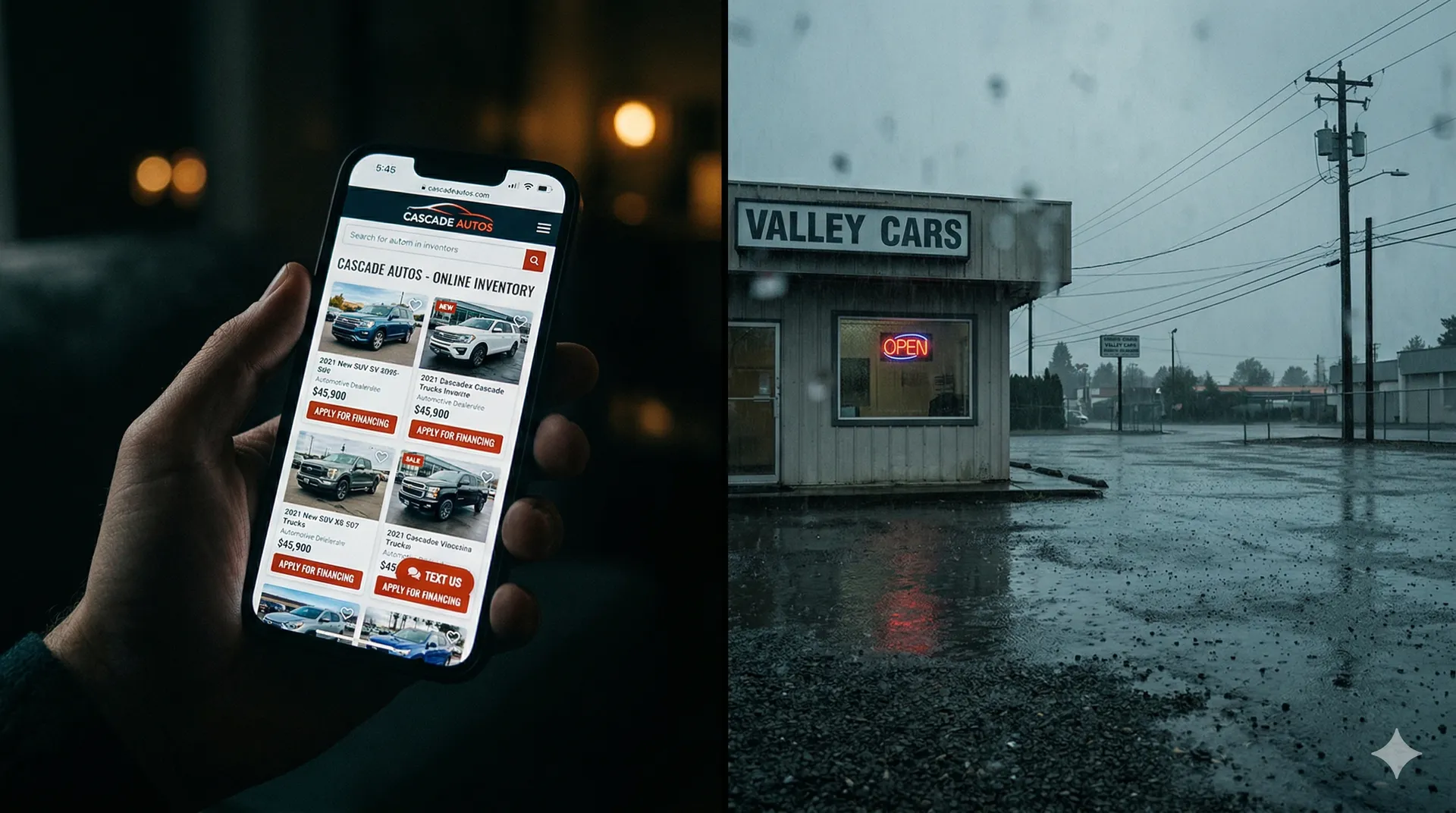
How do modern Southern Oregon car buyers actually decide which dealership to visit? It’s Sunday, 8 PM. James sits on his couch with his phone, scrolling YouTube. His truck is aging; he’s thinking upgrade. He searches: “best used SUVs under $22,000 Oregon.”
YouTube serves reviews. He watches three over 20 minutes. Then he googles “used SUVs Medford” and clicks a dealership website.
They have a 2019 Toyota 4Runner video—45 seconds exterior, interior, features. He likes it. He clicks their Google profile. 4.8 stars. Reviews: “fair dealing,” “no-pressure sales.”
He scrolls more vehicles. Finds a 2021 Chevy Tahoe. Another video. Another good impression.
By 11 PM, James has decided: He’ll visit this dealership Saturday. He’s pre-qualified on budget, narrowed to two vehicles, formed opinion on trustworthiness.
Saturday morning, walking the lot—the sale is already half-won. The dealership doesn’t know it yet, but they’ve made or lost the deal before he shook a salesperson’s hand.
The old car-buying journey is dead. Customer sees lot → enters dealership → speaks salesperson. Modern journey: Research online (evening, smartphone) → Decide dealership → Visit for validation → Close deal.
The statistics are unambiguous:
- 92-95% of car buyers start research online
- Spend 14+ hours researching vehicles, pricing, dealer reputation, financing
- This 14-hour phase is the most critical purchase decision stage
- By lot arrival, customers have identified vehicles, evaluated dealerships, read reviews, determined budget/financing
The dealership is no longer the place of discovery. It’s the place of validation and transaction. The dealership that doesn’t win the digital phase never gets the physical visit.
How The 14-Hour Buyer Journey Breaks Into 4 Phases: Where Dealerships Actually Compete
The 14-hour research journey follows a specific content hierarchy:
| Phase | Duration | Content Type | Dealership Control | Key Metrics |
|---|---|---|---|---|
| Phase 1: General Research | 2-3 hours | Google searches, YouTube reviews, brand comparisons | None (YouTube reviewers control) | — |
| Phase 2: Specific Vehicle Research | 4-5 hours | Vehicle-specific videos, inventory pages, CARFAX, pricing | HIGH — dealership videos compete here | 75% influenced by video |
| Phase 3: Dealership Evaluation | 3-4 hours | Google reviews, BBB ratings, website quality, contact ease | HIGH — reputation is dealership-controlled | 88% trust reviews like recommendations |
| Phase 4: Final Decision | 2-3 hours | Test drive scheduling, financing pre-approval | Moderate | Conversion to visit |
Critical insight: Dealerships control Phases 2 and 3. Generic vehicle reviews (Phase 1) are beyond dealership control. But specific vehicle videos and dealership reviews are areas where individual dealerships directly compete.
Where dealerships WIN or LOSE:
- Phase 2 (Specific Video): Dealership with vehicle-specific videos dominates search. Dealership without videos forces customers to scroll static photos and abandon.
- Phase 3 (Reputation): Dealership with 4.8-star rating wins evaluation. 3.5-star rating loses at final decision stage.
The dealerships winning Medford-Ashland market understand this. Video content + reputation = unbeatable digital presence.
Video Content: The Disproportionate Influencer in the Buyer Journey
The data on video’s influence in automotive research is striking—and actionable:
| Metric | Impact |
|---|---|
| 75% of shoppers influenced by video | 3 in 4 buyers factor video into decision |
| 60% visit dealership after watching vehicle video | Video drives lot traffic directly |
| 70%+ of automotive research on smartphones | Video is preferred format; photos bore users |
The critical insight: Smartphone users don’t want specs or photo galleries. They want a 30-90 second video of a specific vehicle—exterior condition, interior, how doors close, seats feel—to decide if it’s worth visiting.
Yet most Southern Oregon dealerships produce zero video content. They post photos to website/Google Business profile, but rarely produce dedicated vehicle videos. This is a massive competitive miss.
The buyer journey difference:
| Without Video | With Video |
|---|---|
| Search “used Chevy trucks Medford $15,000” | Search “used Chevy trucks Medford $15,000” |
| Click dealership website | Click dealership website/YouTube |
| Scroll photo galleries (20+ vehicles) | Watch 4-5 vehicle videos (30 sec each) |
| Bored after 5 vehicles; move to next dealership | Identifies 1-2 vehicles worth visiting |
| Repeat at 3-4 dealerships | Calls/schedules test drive |
| Time investment: 30-45 minutes | Time investment: 5-7 minutes |
Dealership with video captures serious buyers in 1/6th the time. Dealership without video forces customers to invest excessive time, and many abandon.
This is why Rigs & Rides (4.8★) beats other 4.8★ independents: they invest in vehicle videos. Video + reputation = unbeatable combination.
What Video Types Actually Work: The Three Videos That Drive Conversions
Not all video is equally effective. Successful dealerships produce three specific types:
Video Type 1: Individual Vehicle Walkarounds (30-60 seconds each)
- Exterior condition, damage, paint quality
- Interior condition, seat wear, odors
- Quick feature demo (sunroof, backup camera, infotainment)
- Honest assessment of condition (no hiding flaws)
This is the highest-impact video type. Every vehicle deserves a video. A buyer watching a 45-second video of a specific 2019 Toyota Highlander makes faster, more confident decision than one scrolling 20 photos.
Video Type 2: Dealer Walk & Talk (2-3 minutes)
- Owner or sales manager walking the lot
- Highlighting inventory depth and variety
- Explaining sourcing philosophy or quality standards
- Building trust and personality
Particularly effective for independents (Rigs & Rides, Quality Cars) where owner/manager personality is competitive differentiator. A 3-minute video of the owner talking about sourcing discipline is worth more than a website bio.
Video Type 3: Customer Testimonials (1-2 minutes each)
- Existing customers talking experience
- Specific praise for service, honesty, no-pressure
- Authentic, unscripted delivery
- Tangible proof of reputation
These are moving endorsements. A customer saying “I was nervous about used cars, but these guys were honest and patient” is worth more than any scripted marketing message. This is social proof in video form.
Production requirement: 2-3 videos per week for new inventory. Total production time: 2-3 hours using smartphone camera. Payoff: 6-12 month library of evergreen search traffic.
The Algorithmic Advantage: Why YouTube Videos Show Up in Google Search
Video content gets algorithmic boost from search engines:
| Algorithm Factor | Benefit |
|---|---|
| YouTube prioritizes video content | Especially in “near me” and local searches |
| Google Search integrates YouTube videos | Directly into automotive query results |
| Video engagement metrics | Watch time, comments, shares signal quality to Google |
The evergreen content advantage: A dealership producing 3-4 vehicle videos weekly creates a library appearing in search results for months or years. A customer searching “2019 Toyota Highlander Medford” six months later might discover that dealership’s video—from inventory long since sold.
Why this matters: The video becomes marketing asset long after the vehicle sells. It educates customers about dealership’s quality standards and sourcing philosophy. It says: “This dealership produces honest, detailed content. I can trust them.”
Example: Rigs & Rides produces video on a Ram 3500 in January. Ram sells in February. But the video appears in Google search for “Ram 3500 Medford” for the next 12 months. Every potential buyer sees Rigs & Rides’ professionalism before any other dealership gets their attention.
This is the content compounding effect that separates winners from losers in the 14-hour digital buyer journey.
Google Reviews: The Gatekeeper of Final Decision
While video influences “awareness and consideration” phases, Google reviews dominate “evaluation and decision” phases. By the time a customer has narrowed to 2-3 dealerships, they’re reading reviews intensively.
The impact is decisive:
| Metric | Consequence |
|---|---|
| 88% of consumers trust reviews as personal recommendations | Reviews are decision-makers, not afterthoughts |
| 86% won’t consider companies rated below 4.0★ | Below 4.0 = automatic rejection |
| 4.8+ ★ perceived much more trustworthy | 4.8 vs. 4.3 = massive trust gap |
Critical dynamic: A dealership with exceptional video but 3.5-star rating loses the sale. A dealership with mediocre video but 4.8-star rating wins the sale.
Why Butler Automotive Group and Rigs & Rides rank highest: 4.8-4.9 star ratings. Their reputation precedes them. A buyer who’s scrolled videos and reviews, seeing consistent 4.8+ ratings with “honest,” “no-pressure” testimonials, arrives at the dealership ready to buy.
The sequence matters: Video gets attention (Phase 2). Reviews determine decision (Phase 3). A dealership winning both video and reviews is nearly unbeatable. A dealership with only one loses somewhere in the funnel.
The Integrated Digital Funnel: Video → Reputation → Conversion
The most effective Southern Oregon dealerships build this integrated digital funnel:
| Funnel Stage | Content | Goal | Success Metric |
|---|---|---|---|
| Awareness | Vehicle walkarounds, videos | Get customer spending time exploring inventory | 70%+ of video viewers visit website/call |
| Consideration | Dealer walk & talk, testimonials | Build trust in dealership brand/values | Click to website, schedule test drive |
| Evaluation | Google reviews, BBB ratings | Confirm reputation/trustworthiness | 4.0+★ rating with positive sentiment |
| Decision | Financing info, trade-in appraisal tools | Remove friction from final decision | Test drive booking, lead submission |
Dealerships excelling at all four stages capture disproportionate qualified leads. Dealerships skipping steps (lots of video but poor reputation, or high rating but no video) lose deals at specific stages.
Example failure modes:
- Great video, poor reputation (3.5★): Drives traffic, loses at evaluation phase
- Strong reputation (4.8★), no video: High quality leads, but fewer total leads
- Both strong: Captures both volume and quality; becomes market leader
The dealerships winning Medford-Ashland market have integrated both: Video content at Phase 2 + 4.8-star reputation at Phase 3 = unbeatable combination.
The Southern Oregon Opportunity: Systematic Video Production as Competitive Moat
Most Southern Oregon dealerships produce zero systematic video content. This is a massive opportunity.
A dealership committing to 2-3 videos per week (2-3 hours production using smartphone camera) can:
| Outcome | Impact |
|---|---|
| Increase search visibility | Specific vehicles/searches dominate results |
| Differentiate on digital maturity | Competitors still using static photos |
| Build evergreen content library | Drives traffic for 6-12 months+ |
| Higher engagement and faster sales | Video viewers convert at higher rates than photo scrollers |
For independent dealerships with strong reputations: (Rigs & Rides, Quality Cars, Viking Motors)
Video is a force multiplier. Their 4.8-star reviews prove trustworthiness. Their videos prove vehicle quality. Combined: irresistible digital presence converting research into lot visits at high rates.
For franchise dealerships: Video content allows individual locations (Lithia Honda Medford vs. Eugene) to differentiate and build local personality despite corporate ownership.
For dealerships losing market share: Video + systematic reputation building is the fastest path to competitive recovery.
Post-Sale: Where the 14-Hour Journey Loops Back to Future Buyers
The most strategically advanced dealerships recognize: the 14-hour research journey doesn’t end with test drive. Post-sale communication—customer experience, satisfaction, willingness to recommend—directly impacts online reviews and reputation.
The leaky funnel dynamic:
-
Dealership A: Great video content, poor reputation (3.5★)
- Drives traffic; loses customers due to poor post-sale experience
- Solution: Operational excellence in customer service/follow-up (not more video)
-
Dealership B: Strong reputation (4.8★), minimal video
- Strong customer loyalty; limited new customer traffic
- Solution: Video content amplifies reach to new customers
-
Dealership C: Both strong video + strong reputation (4.8★)
- Captures both volume and quality; becomes market leader
The compounding effect: Every positive post-sale experience generates future reviews that feed Phase 3 (Evaluation) for next buyers. Every negative experience erodes reputation that kills Phase 3 for future buyers.
The Competitive Reality: Integrated Digital + Operational Excellence = Market Leadership
Most Southern Oregon dealerships intellectually understand that buyers research online. Few appreciate the competitive advantage available to dealerships systematically producing video content + maintaining operational excellence.
Butler Automotive Group’s dominance: Extensive video library. Walkarounds for new inventory. Dealership overviews. Customer testimonials. When buyer searches “2019 Toyota 4Runner Medford,” Butler’s video pops in results. Buyer watches clear, professional 45-second overview. Feels confident to visit.
Independent dealership same vehicles, zero video: Buyer scrolls static photos. Bored after few vehicles. Moves to next dealership.
Monthly compounding: Dealership with video captures dozens additional qualified leads monthly. Annually: hundreds additional customer interactions = hundreds additional vehicle sales.
For Rigs & Rides and Quality Cars: Video content is force multiplier on their 4.8-star reputation. Add owner/manager walkarounds building personality and trust, and they become nearly unbeatable in their segment.
The math: At 150 vehicles/month and $1,800 average gross, capturing just 10 additional monthly leads due to better video/reputation = $216,000 additional annual gross profit. This single operational/content decision compounds into dealership dominance.
Common Questions
Q: How much time does video production actually take? A: 2-3 hours weekly for 2-3 videos. Typical workflow: 30-45 min shooting, 30 min editing, 30 min uploading. Low time investment for high ROI.
Q: Should we use professional videography or smartphone? A: Start with smartphone. Professional quality matters less than consistency. Buyers trust raw, honest videos more than polished marketing. Upgrade to professional only after you have cadence established.
Q: How do we get Google reviews? Should we ask customers? A: Yes, ask. A simple text or email after purchase: “Would you mind sharing your experience?” drives reviews. Focus on delighting customers; great service generates organic reviews.
Q: Can video production replace reputation building? A: No. Video and reputation are both required. Video without reputation drives traffic but loses at decision phase. Reputation without video limits traffic. Both are non-negotiable.
Q: How long does a video library take to impact search results? A: 2-4 weeks to appear in results. 2-3 months to show meaningful traffic. Video compounds over time; older videos keep driving traffic long after vehicles sell.
Action Plan for Southern Oregon Dealerships
If you’re independent with strong reputation (4.8★+):
- Start video production immediately — 2-3 videos per week
- Focus on walkarounds and owner/manager messaging — personality is your advantage
- Systematize customer testimonials — ask happy customers for 1-2 minute videos
- Protect your reputation — respond to all reviews (positive and negative)
If you’re franchise:
- Establish local video strategy — differentiate individual locations
- Produce 2-3 videos per week — inventory walkarounds, owner spotlights
- Respond to all Google reviews — builds engagement and algorithmic signal
If you’re struggling:
- Audit your online reputation — what’s your current star rating?
- Fix reputation first — video won’t help if you’re 3.5★
- Then invest in video — combine reputation + content for comeback
Do NOT:
- Wait for perfect video equipment (smartphone is fine)
- Skip posting reviews (Google likes engagement)
- Produce video without reputation work (won’t convert)
- Stop at video production (it’s Phase 2; reputation is Phase 3)
Strategic Takeaway
The modern used car buyer’s 14-hour research journey is won through video content (surfaces vehicles, showcases quality) + exceptional reputation (builds trust, confidence). Dealerships excelling at both convert research into lot visits at significantly higher rates than competitors.
In Southern Oregon’s competitive market, systematic video production is no longer optional—it’s a primary competitive differentiator. The dealership committing to 2-3 weekly videos, combined with operational excellence generating positive reviews, captures disproportionate share of the 14-hour research journey before customers ever arrive on the lot.
The dealership building this into its DNA doesn’t just improve lead generation—it fundamentally positions itself as a modern, trustworthy operator in the eyes of digitally-savvy car buyers. This compounds over months into market leadership. The dealership that ignores video while competitors execute faces years of competitive disadvantage.
Strategic Takeaway
The modern used car buyer’s 14-hour research journey is won through a combination of compelling video content (that surfaces vehicles in search and showcases vehicle quality) and exceptional reputation (that builds trust and confidence). Dealerships that excel at both—that produce consistent, honest vehicle videos and maintain stellar online reviews—convert research into visits at significantly higher rates than competitors.
In Southern Oregon’s competitive market, video content production is no longer optional—it’s a primary competitive differentiator. The dealership that commits to systematic video production of inventory (2-3 videos per week), combined with operational excellence that generates positive reviews, will capture a disproportionate share of the 14-hour research journey before customers ever arrive on the lot. The dealership that builds this into its DNA doesn’t just improve lead generation—it fundamentally positions itself as a modern, trustworthy operator in the eyes of digitally-savvy car buyers.